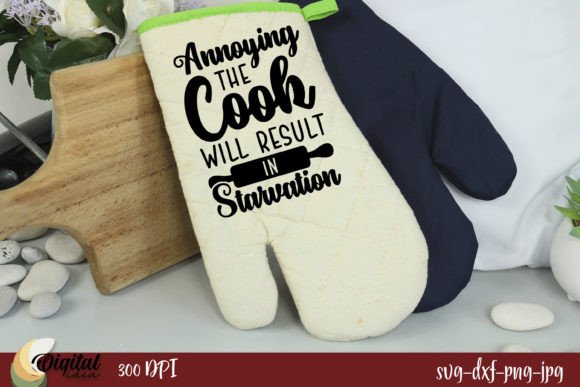
Annoying the Cook: A Designer’s Review
As an embroidery designer who has spent countless hours digitizing and testing files for real-world application, I approach every new machine embroidery design with a critical eye. It is not enough for a graphic to look good on a screen; it must survive the needle, the thread tension, and the wash cycle. Recently, I evaluated Annoying the Cook, a kitchen-themed SVG design that promises to bring humor to domestic spaces. After reviewing the file structure and simulating its application across various textiles, I have formed a clear opinion on where this asset shines and where it requires careful handling.
First Impressions and Visual Personality
The first thing that strikes you about Annoying the Cook is its attitude. It does not try to be overly ornate or delicate. Instead, it leans into a bold, conversational aesthetic that fits perfectly within the modern Crafts and Graphics market. The layout suggests a design meant to be read quickly and appreciated with a smile. For an embroidery project, this clarity is vital. Complex, tiny details often get lost in translation when moving from vector lines to stitched threads, but the visual weight here suggests it will hold up well.
The mood is playful yet assertive. This is not a subtle background pattern; it is a statement piece. When I imagine this stitched onto a canvas tote or a linen apron, I see a product that invites interaction. Customers do not just buy the item; they buy the personality it projects. For Etsy sellers and small shop product creators, this kind of immediate emotional connection is what drives clicks and conversions.
Real-World Application Scenarios
To truly test the viability of Annoying the Cook, I mentally placed it into several common production scenarios. The most natural fit is undoubtedly sweatshirt embroidery. A crewneck sweatshirt provides a stable, flat surface that allows the text and any accompanying graphical elements to breathe. The thickness of the fleece supports the stitch density without puckering, resulting in a professional finished product that feels substantial.
Another strong candidate is the tote bag design. Canvas totes are workhorses in the handmade market. Because they are often used for grocery runs or library trips, they endure frequent washing. If the digitization is sound, this design could become a staple item for a craft business. I also considered it for custom apparel like t-shirts. Here, the challenge increases due to the stretch of the fabric, but the payoff is high for casual wear. A well-stitched humorous quote on a tee is a perennial bestseller.
For those focusing on home goods, consider holiday embroidery or hostess gifts. An embroidered tea towel featuring this phrase makes for a memorable personalized gift. It transforms a mundane kitchen tool into a conversation starter. However, one must be mindful of the fabric texture. Terry cloth towels can swallow small details, so ensuring the design scales appropriately is crucial.
Navigating Technical Challenges
While the concept is strong, the execution depends entirely on how the file is prepared for stitching. Since the product description notes that a zip folder with SVG, DXF, EPS, PDF, JPEG, and PNG formats is attached, it is important to clarify a common misconception among beginners. These are primarily cut files or print graphics. To use Annoying the Cook as a machine embroidery design, you must ensure you have the correct embroidery file formats (such as PES, DST, or JEF) compatible with your specific machine. If these are not explicitly listed, you may need to digitize the SVG yourself or confirm with the seller if embroidery-specific files are included in a different package.
Assuming you have a proper embroidery file, pay close attention to stitch density. Humorous quotes often rely on clean, legible lettering. If the satin stitch is too wide, the letters may snag or lose definition after washing. If the fill stitch is too dense, it can cause the fabric to pucker, especially on lighter materials like cotton poplin used for baby embroidery items or shirts.
I would advise caution when applying this to curved surfaces like caps. The rigidity required for clear text can conflict with the curvature of a hat brim or crown. If you attempt this, use a sturdy stabilizer and consider scaling the design down to fit the available hoop space without distorting the proportions. Similarly, avoid using this on highly textured fabrics where the thread colors might blend into the background, reducing readability.
Enhancing Product Value and Brand Consistency
From a business perspective, Annoying the Cook offers versatility. It allows a brand to show humor, which humanizes the maker. When customers see a well-executed, witty design, their trust in the handmade product increases. It signals that the creator understands current trends and has the technical skill to deliver quality.
For digital embroidery file sellers, offering this as part of a bundle can increase average order value. Pair it with other kitchen-themed designs to create a cohesive collection. For physical product sellers, use high-quality printable mockup images to showcase the design on various items before stitching a single thread. This helps gauge customer interest and reduces waste.
Practical Notes for the Embroiderer
Before committing to a full production run, always test the design on scrap fabric identical to your final material. Check the contrast between your thread colors and the fabric. A dark thread on a dark shirt will vanish; a light thread on a white shirt may lack impact. Use a running stitch outline if necessary to define edges clearly.
Inspect the small details. Are there any tiny jumps or unnecessary trims that could weaken the thread? Does the design require an applique design approach to reduce bulk? These are questions only answered through testing. Also, verify the licensing terms. Just because you bought the design assets does not automatically grant unlimited commercial rights. Confirm whether you can sell the embroidered patch or finished garment, or if the license is for personal use only.
In conclusion, Annoying the Cook is a promising asset for the right project. It brings character and humor to the kitchen and wardrobe. With careful attention to digitization quality, fabric choice, and stabilizer selection, it can elevate a simple item into a standout piece for your commercial embroidery portfolio or personal collection. Treat it with the respect any good design deserves, and it will serve your creative enterprise well.